

You spot a polka dot jacket online and it looks like the perfect fix for a boring wardrobe. Then the questions hit fast. Will the dots make you look sharper or busier, will the fabric feel light enough to wear, and will you still want it next season after the shipping charge and waiting time feel present?
The smartest way to shop is to treat a polka dot jacket as three decisions at once, dot scale, fabric, and silhouette. If you get those right, the jacket wears better, photographs better, and stays useful longer. A clear brand page can help with presentation, but a clear style guide helps even more, and SelfServe's brand and UI guide is a useful example of how design thinking can keep choices easy to compare.
Why Choosing a Polka Dot Jacket Feels Harder Than It Should
A lot of shoppers feel excited for about ten seconds, then frozen. That's because a polka dot jacket isn't just a print, it's a print attached to shape, fabric weight, and the part of your body it sits near. The same jacket can look crisp on one person and overpowering on another, especially once you factor in collar height, sleeve volume, and whether the piece is cropped or relaxed.
The three choices that actually matter
Start with dot scale. Small, evenly spaced dots usually feel calmer and easier to layer. Bigger dots read louder, which can be fun if you want the jacket to do the talking, but they can also dominate a short torso or a narrow frame.
Next comes base fabric. A jacket in cotton acts differently from one in technical polyester or polyamide. The print may look similar in photos, but the way the jacket moves, warms, and breathes is completely different.
Then there's silhouette. Cropped, boxy, oversized, and fitted cuts all change proportion in ways that matter more than people expect. If you shop online from another country, those details matter even more because free global shipping solves the delivery worry, not the fit worry.
Practical rule: buy the jacket for the shape you already wear most often, not for the most dramatic product photo.
If you're unsure where to begin, use a product page like a checklist, not a mood board. Look for the print, then the composition, then the length and chest measurements. That sequence saves a lot of regret.
The Industrial Roots That Made Polka Dots a Wardrobe Staple
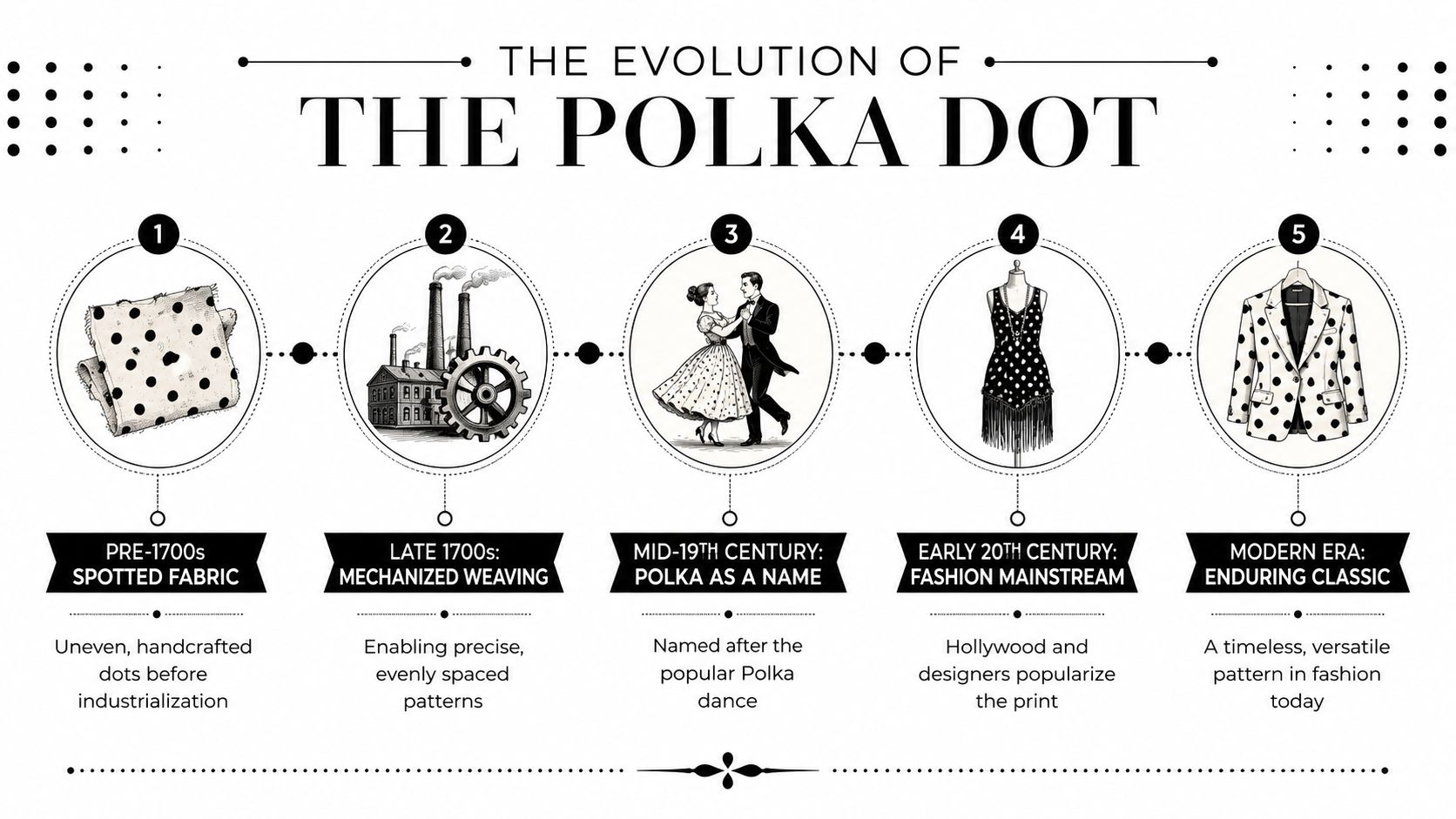
The reason polka dots feel so familiar now is that they became technically easier to make. Before the late 1700s Industrial Revolution, evenly spaced dots were hard to produce at scale. Mechanized weaving made it possible to create identical, evenly spaced dots across cloth, and that changed the pattern from awkward and rare to repeatable and commercial. Before that shift, Europeans often avoided spotty patterns because they could resemble the blotches of plague and smallpox, which made the look culturally loaded as well as visually tricky.
From dance name to fashion label
The name itself has a story too. The word “polka dots” first appeared in print in 1857 in Godey's Lady's Book, which described a muslin scarf with rows of round dots. By then, fashion culture was already borrowing the word polka from the dance craze of the 1840s and 1850s, using it on clothing and textile goods such as the polka jacket and polka hat. The naming wasn't random, it was part of a broader commercial habit of attaching fashionable labels to popular dance culture, as noted in this fashion history timeline.
Why that history still matters now
That background explains why modern polka-dot jackets often look cleaner than older spotty fabrics. The dots are usually more even, more deliberate, and easier to repeat across a garment panel. It also helps explain why the motif keeps coming back in 2025 and 2026 coverage as a recurring style, not a one-off novelty.
A useful way to think about it is this. A print that once moved from socially avoided to widely manufacturable now has the kind of visual stability that makes it easy for brands to cut into jackets, bombers, blazers, and quilted outerwear without losing the effect.
Cotton vs. Technical Fabrics and How Each One Wears
A polka dot jacket can look playful in a product photo and feel completely different once it arrives, because the fabric decides how it behaves on your body. Print is only the first decision. Shell, lining, and fill decide whether the jacket breathes well, traps warmth, sheds drizzle, or feels stiff enough to stay outside all day.
The two main fabric families
Lightweight cotton shells usually act like style layers first. In the examples from major markets, they often pair a cotton lining with polyester padding, which keeps the jacket comfortable for mild weather and indoor wear. That kind of build works over a tee, a knit top, or a simple dress without making the whole outfit feel heavily insulated.
Technical versions sit in a different lane. They are often made from 100% polyester or polyamide shells with wind- and water-resistant finishes, and they may add a hood, a high collar, and cuff closures. That construction pushes the jacket toward cold-climate wear and protection from the elements, especially when the surface is sealed rather than softly woven. A product comparison from La Redoute's fabric details shows how much the shell and finish can change the garment's purpose.
A sealed synthetic shell is built to do more than look cute.
Matching fabric to real life
Autumn commuting, office layering, and city days that move between outside air and heated rooms usually suit cotton better. Rainy days, wind, and colder travel call for a technical shell instead. A cotton shell with recycled polyester fill often feels right in milder conditions, while a sealed polyamide or polyester shell with a hood and higher neck usually makes more sense for colder weather.
If you are shopping across borders, fabric choice matters even more because climates vary so much. A jacket that looks right in photos can feel too warm, too light, or too delicate for your actual weather. For that kind of fit-conscious online shopping, a fabric guide helps you compare labels before you check out, so learn more about fabric choices in our guide here.
| Polka Dot Jacket Fabric Comparison | Breathability | Weather resistance | Best climate |
|---|---|---|---|
| Cotton shell with cotton lining and polyester padding | Higher | Lower | Mild weather, indoor layering |
| Technical polyester or polyamide shell with protective finishes | Lower to moderate | Higher | Cold, windy, or wet conditions |
That is the trade-off in plain terms. Cotton gives you comfort and easier layering, while technical fabric gives you more protection and structure. For international buyers, especially those taking advantage of Arrisco's free global shipping, the safer choice is the one that matches the weather you live in, not the one that looks best in a flat product image.
Dot Scale, Spacing, and Where They Sit on Your Body
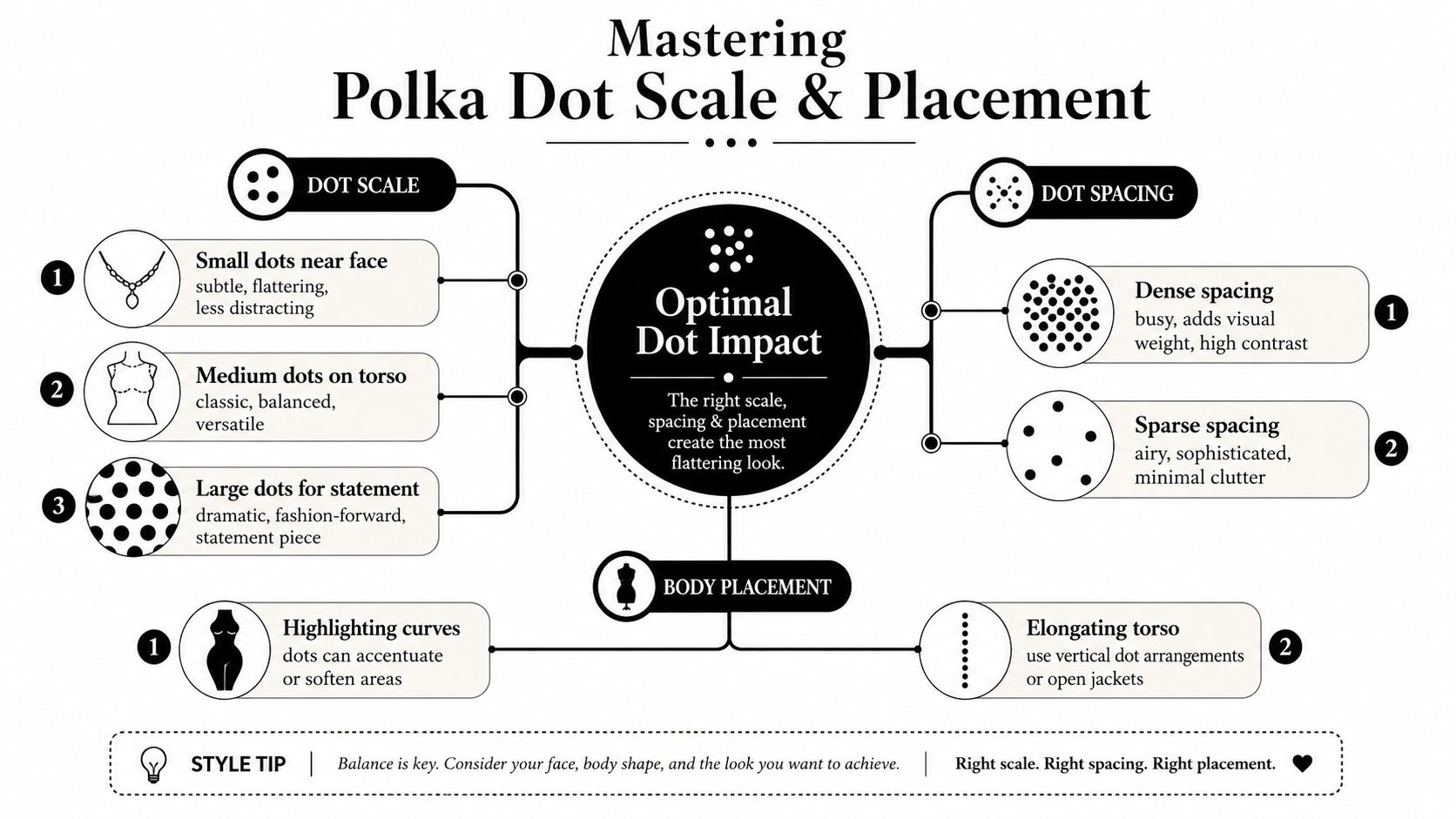
Dot scale is the part most style posts gloss over, but it's one of the most useful things to get right online. The same jacket can feel elegant, playful, or busy depending on how large the dots are, how far apart they sit, and where they land on your frame.
Small, medium, and large dots read differently
Smaller dots usually feel easier to layer and often look more balanced near the face. Medium-scale dots are the most straightforward if you want the print to feel intentional without taking over the outfit. Large dots are bolder, and they work best when you want the jacket to be the focal point rather than the backdrop.
Spacing changes the effect too. Dense spacing adds visual weight and can make the jacket feel busier. Sparse spacing feels lighter and more open, which is useful if you want the print to feel refined instead of loud.
Placement changes the whole conversation
If the jacket has a high collar, hood, or close neckline, the print sits near your face and becomes more noticeable there. That's where dot scale matters most, because one fashion analysis notes that polka dots can be less flattering near the face when the wearer's features are already very angular, while styling guidance often favors rounded, balanced repeats over sharp or asymmetrical motifs. You can read that visual reasoning in this optical-illusion note on polka dots.
If the jacket opens lower on the torso, the print has more room to behave like a pattern field instead of a face frame. That makes it easier to wear with simple layers underneath, especially if your shoulders are broad or your frame is already visually strong.
A simple rule helps:
- Smaller dots near the face: better if you want subtlety and easier layering.
- Mid-scale dots on the torso: best for a classic, balanced look.
- Oversized dots for statement dressing: strongest when the rest of the outfit stays quiet.
For mix-and-match ideas with more than one print, how to mix patterns is the right mindset, because the goal is always balance, not competition.
Fit, Silhouette, and the Numbers That Precisely Matter
Fit changes a polka dot jacket more than many readers expect. The print gets the attention, but the measurements decide whether the jacket feels cropped, roomy, sharp, or casual on your body. Product specs are usually the clearest part of a listing, so read them the way a tailor would, with attention to the facts that shape how the jacket will sit on you.
What the measurements are telling you
Retail product details from major stores often show cropped cotton styles around 22 inches in length with a 42-inch chest for a size Small, while fitted and reversible technical versions sit around 24.5 inches in length. Relaxed-fit jackets fall below the hip, which changes the proportion and gives the garment more coverage. Those measurements matter because shorter lengths reduce fabric bulk and make arm and torso movement easier, but they can also leave the waist more exposed unless the jacket includes a higher collar, elastic cuffs, a drawcord hem, or snow-skirt-style closures.
Fit works like the frame around a print. A cropped jacket can feel nimble and fashion-forward, but it usually asks more from the layers underneath. A longer relaxed jacket can be easier for daily wear, but it may look less crisp if you want a sharper silhouette.
How to shop when you can't try it on
Online shopping makes measurements the deciding factor. Measure a jacket you already wear well, compare chest width and length, and check whether the style is meant to sit at the waist, high hip, or below the hip. If you are between sizes, choose based on whether you want more movement or a cleaner line, because the right answer depends on what you plan to layer underneath.
If you need a clear process, see how to take accurate measurements in our guide here. The product taxonomy itself helps too, because product attributes explained NanoPIM is a useful reminder that the most useful facts are usually the plain ones, like composition, fit type, and dimensions. Those details matter more than the front-facing image when you are ordering from another country, where returns can take more time and patience.
Three Outfit Formulas That Actually Work
A good polka dot jacket doesn't need a dramatic wardrobe to make sense. It needs a few reliable formulas that let the print stay in charge without making the rest of the outfit feel confused. The easiest way to wear one is to build around the jacket's level of contrast, not around whatever is trending that week.
Weekend, office, evening
For the weekend, pair a cropped cotton polka dot jacket with straight-leg denim, a plain tee, and white sneakers. The denim keeps the look grounded, the tee keeps the dots from fighting another print, and the sneakers make the outfit feel lived-in instead of staged.
For the office, choose a technical version over a fine-knit turtleneck in a neutral shade, then add trousers and loafers. That combination works because the jacket brings personality while the base pieces stay disciplined. The result feels polished enough for a work setting without looking severe.
For the evening, go monochrome underneath. A black slip dress or black trousers with a camisole lets the jacket carry the whole outfit, especially if you finish with boots and minimal jewelry. This formula works best when the dots are medium or bold, since the jacket becomes the visual event.
Why these formulas hold up
Each outfit uses the same basic idea. One statement item, then calmer pieces around it. That's why a jacket with a strong dot pattern feels more versatile than people expect, because you can make it casual or dressy just by changing the base layer.
If you're building a blazer-based look, how to style blazers is the right style logic to borrow, even if your version is more playful than corporate. The structure still matters.
A strong print needs a quiet frame. That's what makes the outfit look intentional instead of busy.
Accessories should stay simple. Choose one bag, one shoe style, and maybe one piece of jewelry that doesn't compete with the jacket. The more the dots do, the less everything else has to.
Care, Longevity, and Cost-Per-Wear Thinking
Prints on jackets wear down where the fabric bends and rubs first. That's why care matters so much with a polka dot jacket, especially if you want it to stay sharp after repeated wear. A well-chosen piece can outlast the trend cycle if you treat the surface and structure with a little discipline.
A care routine that protects the jacket
Wash cotton versions inside out, on cold, with similar colors. That helps reduce abrasion on the print and keeps the jacket from fading early. Skip high heat in the dryer, because heat can set in fade and make the outer surface look tired faster than the rest of the garment.
Technical shells need a different approach. Air-dry them to preserve weather-resistant finishes, and don't treat them like a regular sweatshirt. Store heavier jackets on wide hangers so the shoulder line doesn't collapse over time, especially if the fabric has padding or structure.
The infographic checklist on care is useful because it keeps the routine simple. It also matches what is often forgotten first, which is the label.
Thinking in cost per wear
A trend piece only feels expensive if you wear it rarely. That's why cost-per-wear matters more than the sticker price alone. A jacket that gets repeated across seasons starts to justify itself in a way a cheap impulse buy usually doesn't.
The pattern itself has staying power too. The Tour de France polka dot jersey, introduced in 1975, was described in 2025 coverage as a 50-year icon with the same spirit despite changing sponsors over time, including Poulain, Campagnolo, Coca-Cola, Champion, Carrefour, and Leclerc. That long run is a good reminder that dots don't have to feel disposable when the garment underneath is worth keeping.
If you're buying a jacket for more than one season, make sure the care routine matches your habits. A piece that fits your real life and your laundry routine is a better purchase than a prettier one that ends up hanging untouched.
Buying Smart With Arrisco's Free Global Shipping
The easiest way to decide on a polka dot jacket is to run four checks before you buy. First, make sure the dot scale works for your frame. Second, pick the fabric for your climate, not for the photo. Third, choose the silhouette that matches your usual outfits. Fourth, confirm the care instructions so you know the jacket will survive your routine.
That sequence matters even more if you're shopping from outside the brand's home market. Free global shipping lowers the friction of ordering internationally, but it doesn't replace the need to read the size chart, fabric composition, and return policy carefully. If you know your measurements and understand what the jacket is made from, you can shop with a lot more confidence.
A clean buying checklist looks like this:
- Frame and print: decide whether the dots should blend in, balance your proportions, or make a statement.
- Climate and fabric: choose cotton for lighter wear or technical construction for weather protection.
- Shape and length: match cropped, fitted, or relaxed proportions to the clothes you already wear.
- Maintenance: check that the care routine fits your laundry habits before you commit.
The best purchases feel obvious after the fact because the decision was specific from the start. That's the benefit of shopping this category well, you're not just buying a print, you're buying a pattern, a fabric, and a silhouette that can earn space in your closet.
If you're ready to compare a polka dot jacket by dot scale, fabric, and fit instead of by guesswork, take a look at Arrisco. You'll find pieces that make the pattern decision easier for international shoppers, with free global shipping helping the buying process feel less risky. Check the size chart, read the fabric details, and pick the jacket that works for your climate and your frame.