

You're staring at three hooded jackets in your cart. One is a cropped nylon shell in a color you love. Another promises serious waterproofing. The third is a padded parka that looks warm enough for a winter you don't have. The product pages all sound convincing, but none answers the question that matters: which hooded jacket women can wear comfortably in their real climate and daily routine?
Start with your life, not the trend cycle. A jacket for a humid commute needs different priorities from one for mountain trails, and a travel layer shouldn't feel like protective equipment when you're wearing it to dinner. This guide cuts through the noise with a fit-and-climate-first approach, covering fabric technology, hood design, insulation, sizing, styling, care, and online buying confidence.
Finding Your Match in a Crowded Market
Maya keeps switching between the same three tabs. The first jacket has the perfect bright green shade but a stiff shell. The second has impressive weather specifications and enough pockets for a hiking trip, yet she only needs protection for train platforms and sudden showers. The third is a heavyweight insulated style that would be excessive through her mild, wet winter.
Her mistake isn't having too many options. It's judging them by isolated features. A beautiful color can't fix an uncomfortable fabric, and a high waterproof rating won't make a bulky hardshell pleasant for everyday errands.
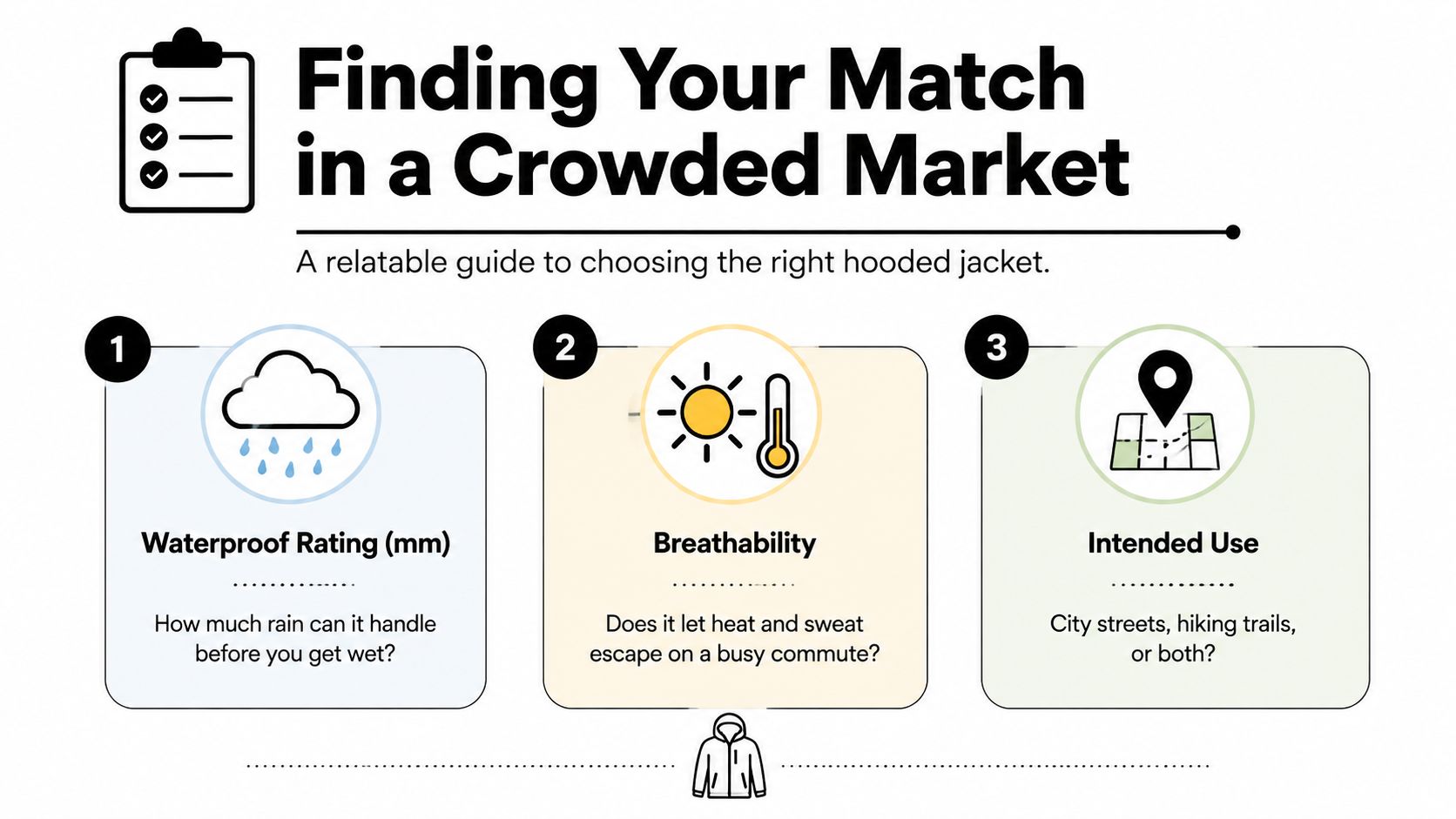
Filter the jacket through your routine
Ask three questions before you compare specifications:
- Where will you wear it? City commuting favors light weight, easy layering, clean pockets, and a hood that doesn't dominate your face. Hiking demands better weather protection, movement, and ventilation. Travel rewards packability and a versatile silhouette.
- How often will it leave the wardrobe? A frequently worn jacket deserves a forgiving fabric, reliable closures, and a fit that works over more than one outfit.
- What weather do you face? Look at heat, humidity, wind, brief rain, and indoor-outdoor transitions. Don't buy for an imaginary blizzard if your real problem is sweating under a shell during a tropical downpour.
The broader women's coats and jackets market was valued at USD 75.03 billion in 2021 and projected to reach USD 102.26 billion by 2028, with a 4.5% CAGR from 2022 to 2028, according to the women's coats and jackets market report. Hooded jackets sit inside this expanding category, but their appeal isn't new. Hooded garments have long served workwear, religious dress, weather protection, and status signaling, while Champion promoted the modern sports hoodie in the 1930s, as described in this history of the hooded jacket.
My shortcut is simple: eliminate anything wrong for your climate first. Then compare the shell, hood, fit, and styling. If two jackets survive, choose the one you'll reach for without thinking. You can also use this practical guide to shopping for clothes online before closing the tabs.
Decoding Fabrics, Insulation, and Weather Tech
Fabric language often makes ordinary jackets sound more complicated than they are. Nylon and polyester shells are common because they're light, durable, and easy to finish with water-repellent treatments. Recycled versions can reduce reliance on virgin fibers, but “recycled” doesn't automatically mean softer, more breathable, or more durable.
A denier rating describes yarn thickness, not a complete quality score. A higher-denier fabric may resist abrasion better, while a lighter fabric feels more packable. A DWR coating helps water bead on the surface, but it isn't the same as a waterproof membrane. Once the surface coating wears down, the jacket may still block some rain if its membrane and seams are sound, but it can feel wetter and less breathable.
Waterproofing is not one single promise
PU and PTFE laminates use a membrane to block liquid water while allowing some vapor movement. A water-repellent finish sits on the surface and mainly delays wetting. Those are different jobs, so don't treat a jacket labeled “water-resistant” as a substitute for a waterproof shell.
Technical buying guides use hydrostatic head to measure water pressure before leakage and MVTR-style measurements to estimate vapor movement over 24 hours, as explained in this waterproofing and breathability guide. The same guide classifies 11,000 to 15,000 mm as good protection for moderate rain, while 15,000 to 20,000 g/m²/24h is considered very good breathability for high-output activity. For heavy rain and intense exertion, benchmarks reach 20,000 mm or more and 20,000 g/m²/24h or more.
Those figures matter only when the construction supports them. Taped seams, zipper protection, hood adjustment, and pressure resistance can decide whether rain gets inside. A highly waterproof shell with poor breathability may leave you damp from condensation.
Insulation changes the whole personality
Down generally offers strong warmth for its weight and compresses well, but it needs careful handling and loses confidence in persistently damp conditions. Look for responsible sourcing such as RDS-certified down when choosing natural fill. Synthetic fibers, including PrimaLoft-style insulation, usually dry faster and keep working more reliably when wet, although they may feel less compressible.
For urban-to-outdoor jackets, targeted insulation can be smarter than maximum loft. One technical pattern uses 60 g insulation in the torso and 40 g in the sleeves and hood, combined with stretch side panels and a wind-resistant face fabric, as shown in the Helly Hansen Odin Stretch Hooded Insulator specifications. That arrangement protects the core while preserving arm movement.
| Material | Best Use | Key Tradeoff |
|---|---|---|
| Nylon shell | Lightweight rain and wind protection | Can feel less soft than woven blends |
| Polyester shell | Everyday outerwear and easy care | May offer less premium hand feel |
| Recycled blend | Sustainability-minded shell or lining choices | Performance depends on the full construction |
| Softshell | Commuting, travel, and active layering | Usually gives up some storm protection |
| Down fill | Cold, dry conditions and compact packing | Needs more care around prolonged damp |
| Synthetic insulation | Variable weather and active use | Can be bulkier than down at comparable warmth |
For a deeper explanation of texture, weave, and performance, use this fabric guide. The right hooded jacket women choose should match the weather they experience, not the most impressive line on a specification sheet.
Comparing Hoods, Features, and Construction
A hood can make a jacket brilliant or irritating. The wrong one collapses over your eyes, catches wind, or creates a strange lump behind your neck. The right one moves with your head and disappears when you don't need it.
A helmet-compatible storm hood usually has a structured peak and several adjustment points. It makes sense for exposed trails, cycling, or serious rain. For city wear, I prefer a low-profile hood with a soft opening and enough depth to cover the head without swallowing the face. Cropped jackets and stand-collar styles often benefit from smaller hoods because excessive fabric overwhelms the shorter silhouette.
Match construction to the job
Baffled insulation creates defined chambers that limit fill movement and retain warmth efficiently. Quilting can distribute insulation neatly and create a more fashion-led appearance, but the stitched channels may add visual bulk. Fleece lining feels immediately cozy, though it can become too warm during indoor transitions.
A two-way zipper helps when you're sitting, cycling, or wearing a longer jacket over a dress. Pit zips are valuable for active use, but they add hardware and can look unnecessary on a minimalist commuter shell. Storm flaps with Velcro improve weather sealing, while uncovered zippers look cleaner and feel quieter.
| Feature | Option A | Option B |
|---|---|---|
| Hood | Structured storm hood for exposure | Low-profile hood for daily wear |
| Insulation | Baffled for warmth retention | Quilted for cleaner visual texture |
| Ventilation | Pit zips for active movement | Minimal vents for streamlined styling |
| Front closure | Two-way zipper for seated movement | Regular zipper for simplicity |
| Cuffs | Velcro for precise sealing | Elastic or snaps for a softer finish |
| Pockets | Higher placement for backpack access | Lower placement for hand warming |
Pocket placement deserves more attention than it gets. High chest or side pockets stay accessible under backpack straps, while lower hand pockets feel better for casual walking. If you regularly carry a phone, keys, and transit card, check pocket depth before admiring the color.
For a polished black insulated silhouette, compare the proportions and hood shape discussed in this black puffer coat guide. My recommendation matrix is blunt: choose a storm hood and ventilation for outdoor exertion, a low-profile hood and clean zipper for commuting, and a packable construction for travel. Don't pay for pit zips you'll never open.
Dialing In Fit and Sizing for Real Bodies
A hooded jacket should move with you before it looks fashionable. Start at the shoulder seam. It should meet the natural edge of your shoulder, not droop several centimeters down your arm unless the oversized shape is intentional.
Online size labels create trouble because a “medium” isn't a universal body measurement. ISO 8559-2:2017 defines primary and secondary dimensions for garment sizing and supports size designations that communicate the body dimensions a garment is designed to fit, while ISO 18890:2018 establishes measurement points and methods for garment dimensions, as explained by the ISO garment-sizing standard. Use those frameworks as a reason to compare measurements, not as permission to trust a letter size blindly.
Use your body as the reference
Before buying, measure your bust, waist, hip, shoulder, and sleeve length according to the brand's instructions. This guide to accurate body measurements will help you create a dependable reference. Compare the product chart with your own numbers, then inspect the intended fit language.
- Shoulders: Choose a close shoulder fit for a sleek shell. Size up only when you need room for thick knitwear or a sweatshirt.
- Sleeves: The cuff should reach the wrist bone when your arms rest naturally. Thumbholes can help longer arms, but they shouldn't pull the sleeve tight across the palm.
- Bust: If the zipper ripples or the front pulls across the fullest point, the jacket is too small even if the shoulders look right. Look for princess seams, stretch panels, or a relaxed chest.
- Hood: The opening should frame your face without pressing into your chin. A hood that collapses backward may need a smaller volume or better adjustment.
- Length: Hip-length works well for commuting and proportionate everyday styling. Thigh-length gives taller frames more coverage. Cropped jackets suit layering over dresses, high-waisted trousers, and wide-leg bottoms.
Narrow shoulders often benefit from shaped seams instead of sizing down, while broad shoulders need mobility across the upper back. Don't size up everywhere to solve one tight point. That can create excess fabric at the waist and make the hood feel heavier.
Fit rule: If you can't raise both arms, sit down, and zip the jacket over your intended base layer, the size is wrong.
Why Hot and Humid Climates Change Everything
The heavy puffer is overhyped for warm, wet cities. In hot humidity, insulation traps body heat and sweat instead of helping you regulate it. A jacket can look luxurious on a product page and still feel unbearable after a short walk between a train station and an office.
The stronger choice is a featherweight nylon shell with a breathable lining, a low-bulk hood, and enough room for air movement. Mesh-lined hoods reduce the sticky feeling around the face. Side vents help release heat. A water-repellent finish handles a brief shower without turning the jacket into a sealed plastic layer.
Runway coverage for projected 2026 trends highlights lightweight cotton, nylon, and utility silhouettes for transitional weather, including hooded styles designed around brief rain rather than deep insulation, as reported in the summer 2026 jacket trend coverage. That direction makes sense for younger shoppers who want protection without the puffed outline.
For cities such as Miami, Lagos, Singapore, and Mumbai, prioritize ventilation, packability, and a shell that dries quickly. A hooded jacket women wear in these conditions should protect against sudden rain while staying presentable indoors. If you're dressing for a night out, the same logic works with the sharper styling ideas in this summer clubbing outfit guide. A cropped wind shell over a slip dress is more useful than a padded jacket you'll carry instead of wear.
Outfit Formulas for Trendsetters 18 to 35
The jacket sets the silhouette, so build everything else around it. Don't force a delicate outfit under a huge technical parka or pair a cropped shell with layers that fight its proportions.
Streetwear without the costume effect
Start with an oversized hooded jacket, cropped wide-leg cargos, retro runners, and a small crossbody bag. Keep the base neutral if the jacket has a statement color. If the jacket is black, stone, or olive, let the cargos or shoes carry more visual energy.
The cropped trouser hem balances a roomy upper layer. The crossbody keeps the outfit practical and stops the jacket from looking shapeless. Choose a lightweight shell for warm cities or a lightly insulated cut when the temperature demands it.
Smart casual with a sharper line
Wear a mid-length matte shell over a fitted ribbed midi dress. Add chunky loafers and a structured tote. The jacket should skim the body rather than balloon around it, with a hood that folds neatly behind the neck.
A neutral jacket lets the dress provide color. A statement jacket works better over a monochrome base, especially when the dress has a clean texture. Keep the hardware restrained. Technical details should support the outfit, not dominate it.
Travel that survives real movement
Choose a lightweight packable hooded jacket with matching joggers, slip-on sneakers, and a compression pouch. The coordinated base creates a deliberate look, while the jacket handles changing conditions during transit.
Use a tailored cut if you'll wear it through museums, cafés, and dinners. Pick a brighter color if the rest of the outfit stays tonal. The best travel jacket is easy to put on, easy to stow, and comfortable over the layer you're wearing, not the imaginary outfit in your packing plan.
Care Labels, Smart Shopping, and Free Shipping
A jacket's care label is a performance document. In the United States, textile wearing apparel must carry a permanent, legible care label that remains available through the product's useful life. If packaging or folding hides the label at sale, the care information must also appear on the package or a hang tag, according to the FTC care-labeling rule.
Keep the shell and finish working
Use this simple routine:
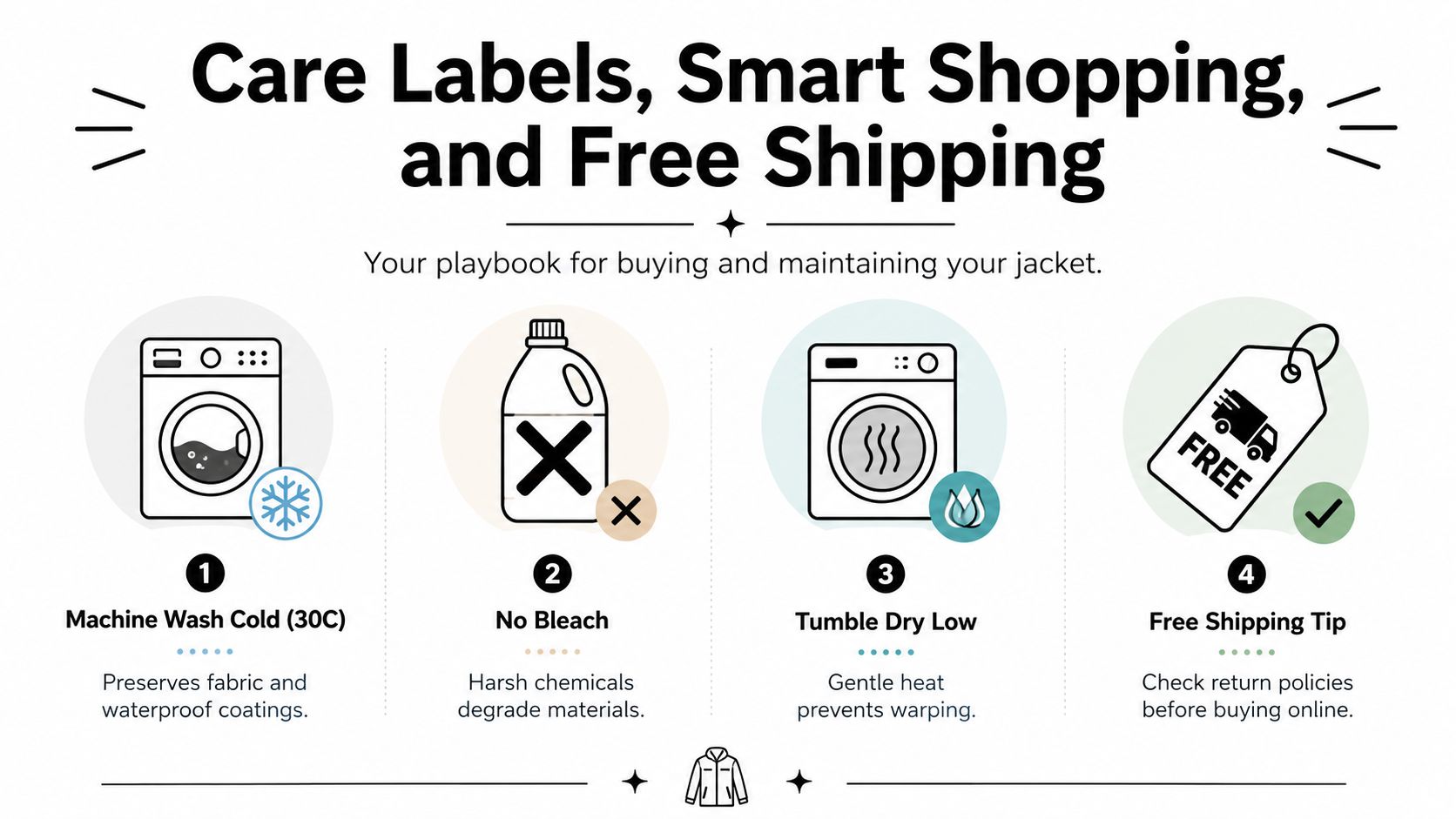
- Wash cold: A machine wash at 30C is a common gentle choice when the label permits it. It reduces unnecessary stress on coatings and fibers.
- Skip bleach: Bleach can damage face fabrics, membranes, elastic, and water-repellent finishes.
- Dry low: Tumble drying on low can help restore some DWR performance when the care label allows it. Never assume high heat is safe.
A technical wash product can remove body oils without leaving heavy residue. For insulated pieces, dry them completely and follow the label's instructions rather than improvising with aggressive heat. Store padded jackets uncompressed so the insulation can retain its loft.
Check safety and sizing before paying
U.S. clothing textiles use a three-class flammability system. Class 1 is acceptable for wearing apparel, Class 2 is intermediate and should be used with caution, and Class 3 is dangerously flammable and isn't permitted for wearing apparel, according to the CPSC clothing-textile fact sheet. The standard covers exposed apparel parts, including unlined hoods and exposed linings in full-front zippered jackets, as clarified by the CPSC clothing flammability FAQ.
Sizing charts may use US letter sizes, EU numeric sizes such as 34 to 46, or UK numeric sizes such as 8 to 20. Don't convert by memory. Match your bust, hip, and sleeve measurements to the seller's chart, then confirm whether the jacket is cropped, fitted, relaxed, or oversized.
Domestic returns can cost time and postage, especially when the wrong shoulder width or sleeve length forces a second order. Arrisco offers free global shipping, and its fit-first construction gives international shoppers a clearer path to choosing a women's hooded jacket online. Once the climate, measurements, and use case are right, the remaining decision really can be color.
Arrisco offers contemporary hooded jacket women styles for shoppers who want climate-aware layers, practical fits, and international delivery without a separate shipping charge. Visit Arrisco to compare lightweight and fashion-led outerwear, check the measurements, and choose the jacket you'll wear.